Loomwork · № 009
First agent, end to end
·5 min·Loomwork
Vamshi Krishna V.
Patient work, woven in public.
This is Thread 09 of Loomwork. New here? Thread 01 explains why this newsletter exists — 2 minutes.
Open Foundry today and there's something new at the center of it.
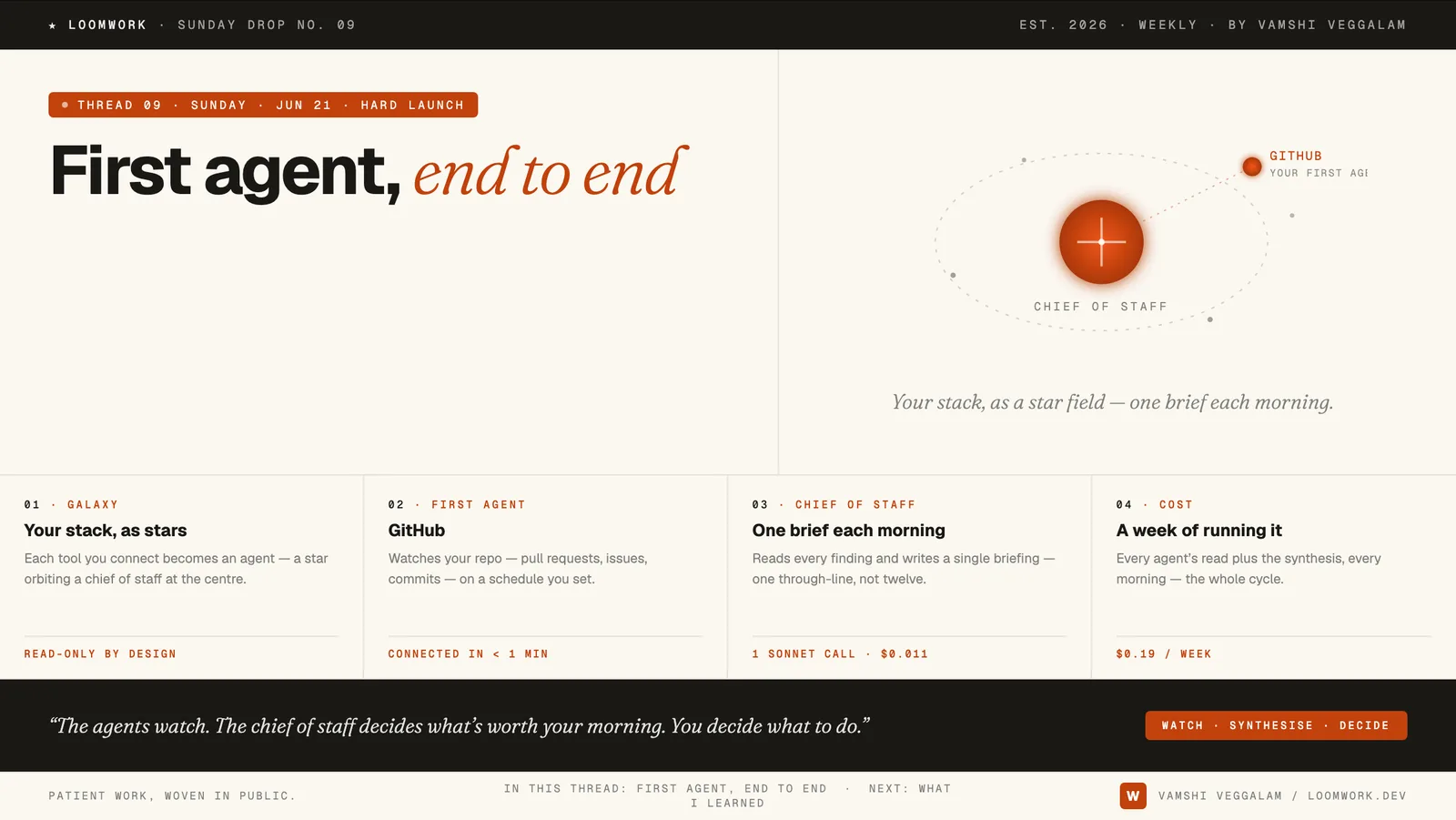
Your stack — the tools you actually run — drawn as a field of stars. Each tool you connect becomes an agent: a star that quietly watches that one tool. And at the center, a chief of staff. It watches nothing itself. It reads what every agent found and writes you a single briefing each morning.
Eight weeks of building in public were pointed at this. Here it is, live.
Set up your first agent.
You start with an empty field — orbit rings, the chief of staff pulsing at the center, nothing watching yet. You connect one tool. Mine was GitHub: a read-only token, the repo to watch, under a minute. A star appears. That's your first agent. It now watches that repo — pull requests, issues, commits — on a schedule you set.
That's the whole motion: a tool you already use becomes an agent that watches it for you. Connect a second, a second star appears. The field fills in as your stack does.
The briefing.
Here's what the chief of staff wrote me this morning — real, unedited.
It read what my agents found and picked one through-line: the admin panel had gone down and come back. It tied two merged pull requests to the two bugs they fixed. Then — the part I didn't expect to value most — it flagged what it couldn't confirm: "no deployment record — unclear if these are live in production." It didn't pretend to know. And it escalated, on its own, that two auth failures had surfaced the same day and the admin flow deserved a look.
That's a junior chief of staff doing exactly its job: read everything, surface the one thing that matters, be honest about the edges. One model call. About a penny.
The agents watch. The chief of staff decides what's worth your morning. You decide what to do.
What's watching — and what it can't touch.
Today these are monitoring agents: they watch and report, nothing more. Read-only by design — an agent can see your GitHub or your Vercel, it cannot change them. That constraint is deliberate, and it's the first thing I'd want to know before handing anything access to my own stack.
Two are live on mine right now — GitHub and Vercel. The catalog behind the wizard is larger, but the honest state today is simple: you connect the tools you use, and each one becomes a star reporting to the center.
What it costs.
A full briefing cycle — every agent's read plus the chief of staff's synthesis — costs about a penny. I ran it every morning for a week: nineteen cents. In Thread 07 I projected ~$54/month; that figure is the platform at full scale — dozens of agents across dozens of services. The first one, watching two, runs under a dollar a month. The ceiling is real. I'm nowhere near it yet, and it's worth being precise about the gap between the projection and today's bill.
See your own.
The star field above is test user. Open Foundry, connect one tool, and tomorrow morning you'll have your own briefing — your repo, your chief of staff. Not a video of my screen. A thing you can run.
The architecture is from Thread 06. The model selection is from Thread 07. The classifier work is from Thread 08. The briefing at the top is what those compose into. None of the earlier threads were a teaser — each was a piece of this one.
Next Sunday: what I learned shipping it. One thing that worked better than I expected. One thing I have to redesign. One assumption that turned out wrong.
See you then.
— Vamshi
Loomwork is by Vamshi Krishna Veggalam. Building Foundry at mindloomhq.com. Find me on LinkedIn.
This thread first ran on LinkedIn on June 21, 2026 — the conversation is over there. Read it on LinkedIn and join the thread