Loomwork · № 002
The 40-tool problem
·5 min·Loomwork
Vamshi Krishna V.
Patient work, woven in public.
This is Thread 02 of Loomwork. New here? Thread 01 explains why this newsletter exists — 2 minutes.
Last Sunday I told you I had no idea what I was running. Here's what I mean by that.
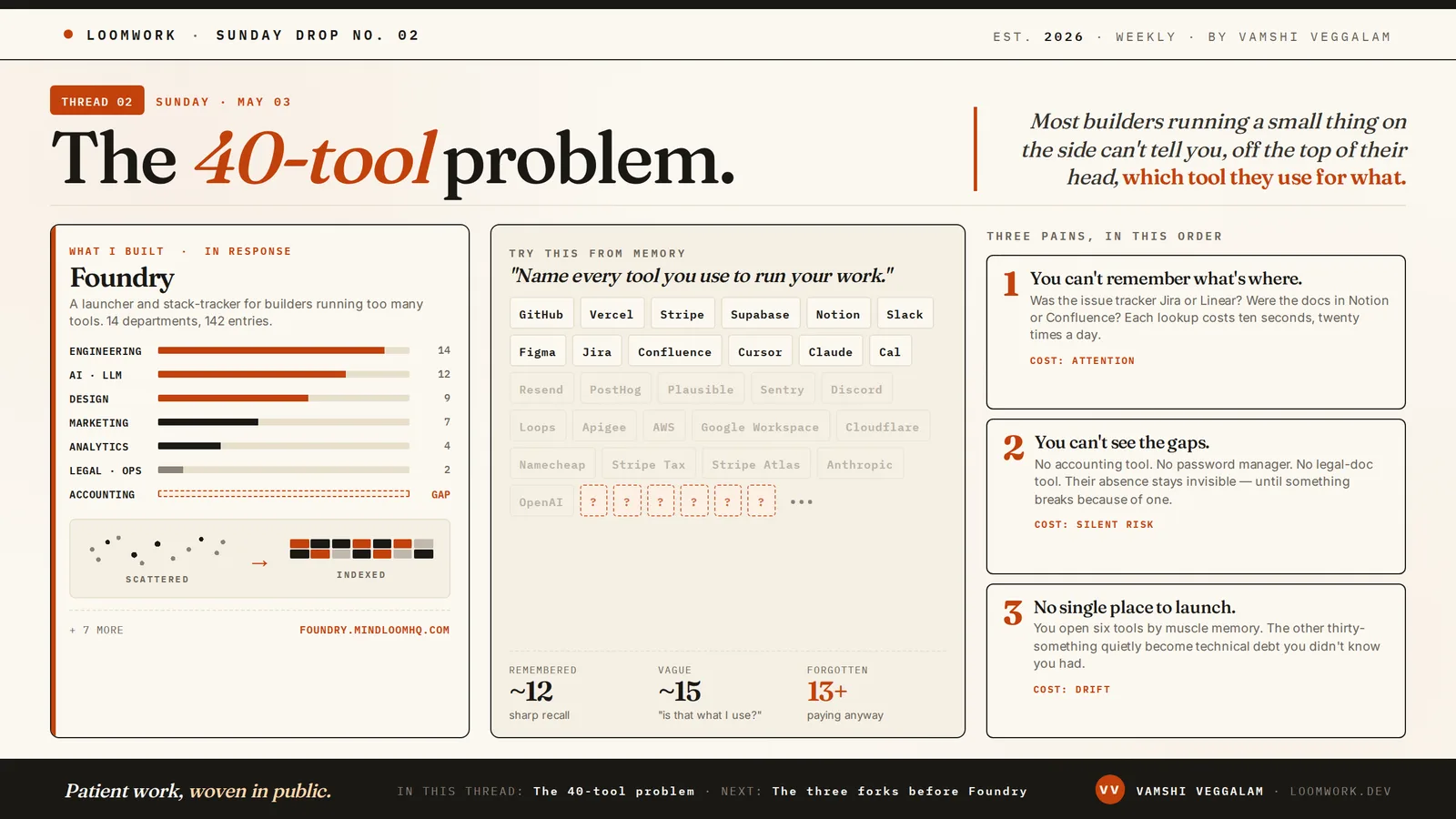
Open a new browser tab right now. Try to list, from memory, every tool you use to run your work — every dashboard you log into, every service that sends you a monthly receipt, every URL that's bookmarked somewhere you can't quite find.
If you're like most people doing this, you'll get to about twelve. You'll feel pretty good. Then you'll remember a thirteenth, and a fourteenth, and slowly it dawns on you that the actual number is much higher than the one you can recall.
The shape of the problem isn't too many tools. The shape of the problem is you can't see what you have.
This is a different problem than the one most discussions assume. The standard complaint is "SaaS sprawl is expensive" — and it is, somewhat — but cost isn't what makes it hurt day-to-day. What hurts day-to-day is three things, in this order:
One — you can't remember what's where. When you need the issue tracker, was it Jira this quarter or did the team move to Linear? Where do the docs live again — Confluence or Notion? When you need analytics, was it PostHog or Plausible — and weren't those for two different things? Each lookup costs ten seconds and a small drain of attention. Multiply by twenty-plus times a day.
Two — you can't see the gaps. When you don't have a single inventory, you don't notice what's not there. Most builders I know have no formal accounting tool, no formal legal-doc tool, no real password manager. They'd benefit from each, but the absence is invisible until something goes wrong. You can't fix a hole you can't see.
Three — there's no single place to launch. You open the same six tools every morning by muscle memory. The other thirty-something fade. Some of them quietly become stale. Some quietly auto-renew for tools you forgot you signed up for. Most quietly become technical debt you didn't know you had.
What you actually want is small and unsexy: a place that knows what you have, organized the way you think, that opens the right tool in one click, and shows you the gaps. Not a dashboard. Not an AI copilot. Not a unified-inbox-of-everything. Just a launching surface that respects the fact that your stack is yours and your brain is doing real work that doesn't need to be replaced.
Most people I've described this to nod and say "yeah, that would be useful." None of them have built it.
The thing about useful boring software is that nobody gets famous for shipping it.
I built it anyway. It's called Foundry, and it's at foundry.mindloomhq.com if you're curious enough to look. It's small on purpose — it doesn't sync your data, doesn't notify you when things change, doesn't have AI in it (yet). It works best on desktop right now; mobile is broken in a way I haven't fixed yet, which is its own story for later. There's a lot still missing, and most of the build is still ahead of us.
The point of this newsletter isn't to sell you on Foundry. The point is the build itself — the doubts, the changes of direction, the things I've gotten wrong, the things I'll get wrong next.
Next Sunday I'll tell you about the three early forks in the road I took before I landed on a launcher — what I considered, what I deferred, and what I cut entirely.
See you then.
— Vamshi
Loomwork is by Vamshi Krishna Veggalam. Building Foundry at mindloomhq.com, with the full archive at loomwork.dev. Find me on LinkedIn.
This thread first ran on LinkedIn on May 3, 2026 — the conversation is over there. Read it on LinkedIn and join the thread